

Executive Protection in the Netherlands: “That Won’t Happen to Me” – Until It’s Too Late
Executive Protection in the Netherlands: “That Won’t Happen to Me” – Until It’s Too Late
It’s Tuesday morning, 7:30 AM. You step out of your Mercedes in front of your office in Amsterdam-Zuid. Same place, same time, every day. You check your phone as you walk toward the entrance. Suddenly, two men are standing in front of you. Before you realize what’s happening, you’re pushed against your car. Your Rolex is gone. Your wallet. Your phone. In 45 seconds, it’s over.
This isn’t a Hollywood scenario. This happens in the Netherlands—in Amsterdam, Rotterdam, and The Hague—to entrepreneurs, executives, and wealthy individuals. And it’s happening more frequently.
The Dutch Illusion: “That Doesn’t Happen Here”
The Netherlands is known as a safe country. And it is—relatively. But “relatively safe” doesn’t mean “immune to danger.” If you belong to a certain category—wealthy, visible, successful—you’re not the average Dutch person. You’re a target.
The most dangerous belief? “The Netherlands is safe. This won’t happen to me.”
The Hard Numbers: Rising Security Threats
According to police statistics:
- Violent incidents against wealthy individuals in the Randstad increased by 34% over the past five years
- Home invasions at expensive addresses: up 28%
- Targeted thefts of luxury watches and jewelry: up 41%
These aren’t statistics from Mexico or Brazil. This is the Netherlands. 2025.
When “Being Down-to-Earth” Becomes Dangerous
Dutch directness and pragmatism are wonderful qualities. But they can also create a blind spot. “I don’t make a fuss,” “I don’t want to draw attention,” “That’s excessive.”
Until you:
- Have a stalker who knows where your children go to school
- Receive online threats after a controversial business decision
- Have a fired employee who wants revenge
- Appear in the media with your wealth or company sale
- Notice the same car has been following you for three days
Then it’s no longer “excessive.” Then it’s too late.
Real Executive Protection Cases in the Netherlands
These stories aren’t made up. They happen regularly across the Netherlands.
Case 1: The Tech Entrepreneur from Het Gooi
A successful exit from his tech company. The deal was widely covered in the media, including interviews about his “new life as a millionaire.” Three weeks later: a break-in at his home in Blaricum while his family slept. The burglars knew exactly where to go—his safe, his cars, his jewelry. They had observed him. They knew his routine.
Only after the incident did he realize: his visibility had made him vulnerable.
Case 2: The CEO from Rotterdam
Major restructuring. 200 layoffs. One former employee began following him. Showed up at his gym. At his favorite restaurant. Sent messages: “I know where you live.”
The police could do little—there was no direct criminal offense yet. But the threat was real. Only when professional executive protection became visible did the stalker stop.
Case 3: The Real Estate Magnate from The Hague
“I’ve never had problems,” he thought. Until his 16-year-old daughter was followed after school. An attempted kidnapping. Failed, fortunately, because a bystander intervened.
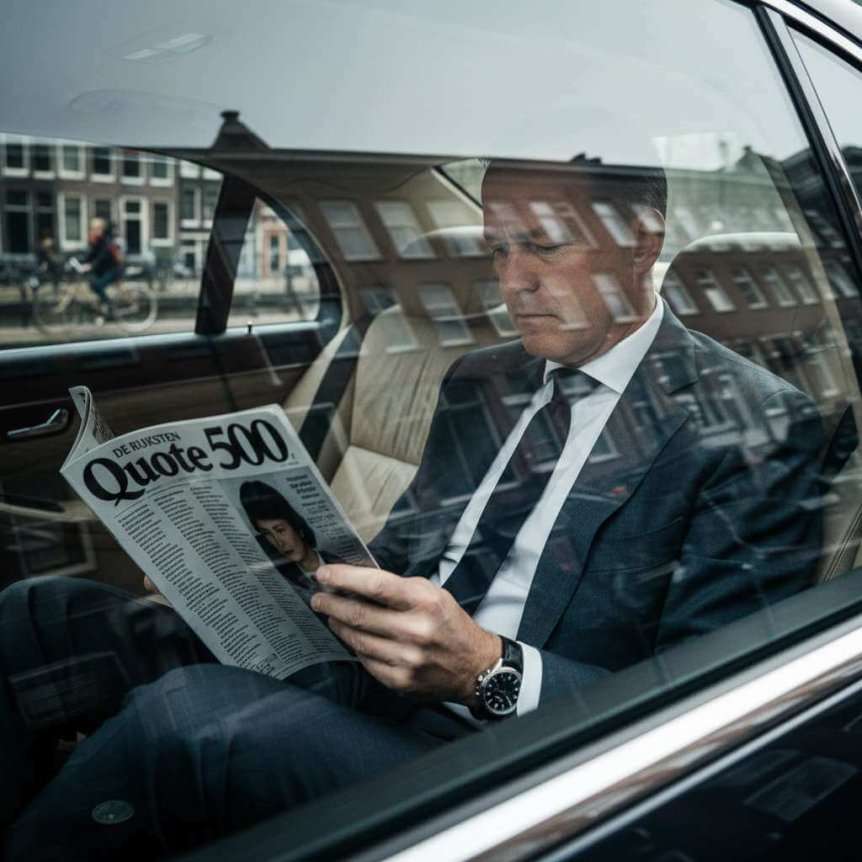
He hadn’t realized: his name in the Quote 500, his visible wealth, his predictable routines—it made his family a target.
Are You a Target? Security Risk Assessment Checklist
You might think: “This won’t happen to me.” But honestly check this list:
Financial Visibility
- Are you listed in the Quote 500 or other wealth lists?
- Have you recently sold a company or closed a major deal?
- Do you drive a car worth €100,000+?
- Do you regularly wear luxury watches or jewelry?
- Do you live in a known “wealthy” neighborhood (Wassenaar, Blaricum, Aerdenhout)?
Public Visibility
- Do you regularly appear in the media?
- Do you have a public LinkedIn profile with your position and company?
- Do you post on social media about your lifestyle, travels, or possessions?
- Are you involved in controversial decisions (layoffs, closures, restructurings)?
Predictability
- Do you follow the same route to the office every day?
- Do you go to the gym at fixed times?
- Do you have regular restaurants or locations you visit?
- Do you always park in the same spot?
Elevated Risk
- Have you recently fired people or had business conflicts?
- Have you gone through a divorce with asset division?
- Are you involved in legal disputes?
- Have you received threats (online or offline)?
If you answer “yes” to 3 or more of these questions, you’re a potential target for security threats.
What Criminals Know (And You Don’t)
Modern criminals aren’t stupid. They’re organized, patient, and professional. They observe. They plan. They wait for the perfect moment.
They Know:
- Your routine: When you leave, where you go, how long you’re away
- Your vulnerabilities: When you’re alone, where you’re unprotected
- Your possessions: What you wear, what you drive, what you have
- Your family: Where your children go to school, where your partner works
- Your home: Security, entry points, blind spots
And they know this because you tell them—through your predictability, your social media, your visibility.
The Real Cost of No Security
Let’s talk about the real costs. Not to scare you, but to make you aware.
Financial Costs
- Stolen luxury watch: €15,000 – €80,000 (average value Rolex/Patek Philippe)
- Home invasion: €8,000 – €35,000 in stolen goods
- Property damage: €2,500 – €8,000 (forced doors, broken locks, vandalism)
- Legal assistance after incident: €5,000 – €15,000
- Increased insurance premiums: 15-25% increase for 3-5 years
- Security upgrades after the fact: €10,000 – €50,000
Personal Costs
- PTSD after violent incident: years of therapy
- Fear and paranoia: impact on quality of life
- Family trauma: children who no longer feel safe
- Reputational damage and media attention
- Loss of privacy
- Sleep problems and hypervigilance: months to years
Business Costs
- Missed meetings and deals during recovery
- Loss of confidence from investors and partners
- Productivity loss due to fear and distraction
- Need to relocate or adjust lifestyle
- Time lost to police, insurance, legal procedures
The question isn’t whether security is expensive. The question is what it costs if you don’t have it.
Executive Protection in the Netherlands: What It Really Means
Executive protection isn’t a big guy in a black suit walking next to you. That’s Hollywood.
In the Netherlands, where discretion and normalcy are important, professional security looks different.
What Professional Executive Protection Entails
1. Threat Assessment
It begins with a thorough analysis of specific risks:
- Who are you and what makes you a potential target?
- What are your daily routines and vulnerabilities?
- Which threats are real for your situation?
- What is your public footprint (media, social media, visibility)?
2. Discreet and Professional
Good security isn’t conspicuous. Close protection officers are professionally dressed, speak fluent Dutch and English, and adapt to your environment. At a business lunch? They sit at another table. At an event? They’re present but invisible.
3. Prevention, Not Reaction
The goal is that nothing ever happens. This is achieved through:
- Route variation: Never the same path twice
- Advance security: Every location is checked beforehand
- Counter-surveillance: Detecting observation before it becomes a threat
- Secure transport: Safe transportation in inconspicuous or armored vehicles
- 24/7 monitoring: Continuous threat intelligence and updates
4. Flexible Security Solutions
You don’t always need full-time security. There are various options:
- Event security: Protection during specific events
- Travel security: Security during business trips
- Residential security: Home security and family protection
- Part-time security: Protection during high-risk moments
- Security consultancy: Advice and risk analysis without permanent security
The Wake-Up Call Moments
People often realize too late that they’re vulnerable. These are the moments when it’s too late:
Moment 1: The Near-Incident
“Someone was standing by my car. When I got closer, he walked away. Maybe it was nothing, but…”
It wasn’t nothing. It was surveillance. You were lucky they didn’t act that day.
Moment 2: The Online Threat
“Someone commented on LinkedIn with ‘I know where you live.’ Probably a troll, but…”
Maybe. But why take the risk? Threats often start online before they become physical.
Moment 3: Media Exposure
“I’m appearing in Quote next week. My wealth will be public. Should I be worried?”
Yes. Visibility = vulnerability. This is the moment to be prepared, not to react afterward.
Moment 4: The Family Member
“My wife said she was being followed. She’s probably being oversensitive, but…”
Women often have better intuition for danger than men. If your partner feels unsafe, take it seriously.
Moment 5: The Business Enemy
“I have a competitor who’s really angry about a deal I made. He threatened, but he probably doesn’t mean it…”
People who threaten sometimes do mean it. And even if they don’t, the fear and uncertainty are real.
Why Wait Until It’s Too Late?
Here’s the hard truth: every victim of a violent incident, robbery, or threat thought beforehand, “that won’t happen to me.”
100% of them were wrong.
The question isn’t “can this happen to me?” The question is: “Am I willing to take the risk?”
What If You Wait?
If you wait until something happens:
- You react from fear, not from control
- You already have damage—financial, emotional, reputational
- Your family feels unsafe
- Your productivity and focus are compromised
- You’re in crisis mode instead of prevention mode
What If You Act Now?
If you act now:
- You’re proactive, not reactive
- You minimize risks before they manifest
- Your family feels protected
- You can focus on your work and life without constant worry
- You have control over your safety
The Dutch Mentality: Security Is Not “Making a Fuss”
“Just act normal, that’s crazy enough.” Security feels like “making a fuss.”
But is it making a fuss to insure your house? Your car? Your health?
No. That’s sensible risk management.
Professional security is the same. It’s not paranoia. It’s not arrogance. It’s not “feeling more important than you are.”
It’s just sensible.
What Can You Do? Take Control of Your Security
If you’re reading this and thinking “maybe I should think seriously about this,” that’s already a step in the right direction.
Step 1: Evaluate Your Risk
Look honestly at your situation. Are you visible? Predictable? Vulnerable? Use the checklist earlier in this article.
Step 2: Seek Professional Security Advice
Talk to a professional security advisor. Have a threat assessment done. Get an honest picture of your risks—without a sales pitch.
Step 3: Take Control
If security makes sense for your situation, implement a plan that fits your life. Discreet, professional, effective.
Conclusion: The Choice Is Yours
This article wasn’t written to scare you. It was written to make you aware.
The facts are simple:
- Violence against wealthy individuals in the Netherlands is rising
- Visibility makes you vulnerable
- Predictability makes you an easy target
- Criminals are professional and patient
- The cost of an incident is higher than the cost of prevention
You can ignore these facts and hope you’re lucky. Or you can be proactive and manage your risks.
The choice is yours.
But if you ever find yourself in a situation where you think, “I could have prevented this,”it’s too late.
“That won’t happen to me” isn’t a strategy. It’s a gamble.
And with your safety and that of your family, you don’t want to gamble.